
















 English
 Français
 Deutsch
 Português
 Español
 русский
 한국어
 العربية
 Italiano
 Indonesia
 Schweiz
 Polski
 Nederlands
 ישראל - עברית
 Perzisch
 ไทย
 日本語
 ኢትዮ-አማርኛ
 Việt Nam
 Kiswahili
 Srpski
 Ελληνικά
 繁體中文
Heat Pump Fans for Cold Climate Operation
11/10/2026A heat pump designed for a cold climate must operate across changing outdoor temperatures, snow conditions and periods of frost. The outdoor fan supports airflow through the heat exchanger, while the heat pump controller manages heating and defrost according to the equipment design.
Why frost changes the operating conditions
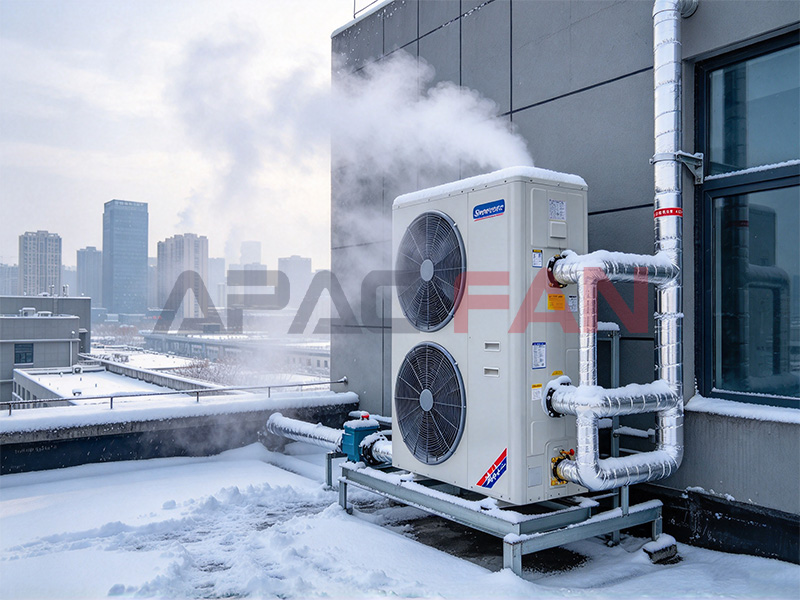
During heating, the outdoor coil can be colder than the surrounding air. Under suitable temperature and humidity conditions, moisture can freeze on the coil. As frost accumulates, it can obstruct air passages and affect heat transfer. The system's defrost function removes frost according to its own control logic.
A fan stopping during a defrost cycle is not automatically a fault. The sequence varies by manufacturer and design. Before diagnosing the fan, compare the observed behavior with the unit's instructions and record whether normal heating resumes afterward.
Protect the air path in winter
Outdoor placement matters as much as the fan itself. Snow accumulation, roof discharge, drifting snow and ice buildup can obstruct intake and discharge openings. Maintain the equipment manufacturer's required clearances and avoid directing discharge air back toward the inlet.
Defrost water must be able to drain in accordance with the installation design. Repeated freezing around the base or outlet can create an obstruction. Snow guards, stands or other protective measures should be evaluated for the specific site and must not restrict the unit's airflow.
Check the fan's permitted environment
Confirm the minimum and maximum operating temperatures, moisture protection, mounting position and electrical supply for the exact fan assembly. Also check whether cables, connectors and any external controller are suitable for the same exposure. An IP rating alone does not establish suitability for all freezing or icing conditions.
Selecting a replacement
Provide the original fan reference, dimensions, airflow direction and control information. The replacement should be checked against the heat pump's complete heating and defrost sequence. APAC FAN can help review available fan information when you share the unit details and an email or WhatsApp number.
Why cold weather changes the outdoor unit's job
During heating, the outdoor heat exchanger absorbs energy from outdoor air. Its surface can be colder than the surrounding air, and moisture may freeze on the surface under suitable conditions. Frost can build even when the outdoor temperature feels only moderately cold. Both temperature and humidity influence the likelihood and rate of accumulation.
As frost builds, the space available for air to pass through the coil can decrease. The resulting resistance can change the fan's operating point and reduce heat transfer. A heat pump's control system is responsible for recognizing when defrost is required and managing the sequence. Adding a higher-output fan is not a substitute for a functioning defrost system.
Understand the defrost sequence
A common defrost approach temporarily reverses the refrigeration cycle so that heat is delivered to the outdoor coil. Other approaches exist, and individual manufacturers implement different control strategies. Outdoor fan behavior during the cycle may differ from its behavior during normal heating. Consult the service instructions for the actual equipment rather than assuming that a stopped fan always indicates a failure.
An operator can record the time of the event, weather conditions and whether normal heating returns after the cycle. An unusually long interruption, repeated alarms or persistent heavy ice after the expected sequence should be assessed by a qualified technician. Avoid attempting to force the fan to run or override a protective control during defrost.
Snow, wind and air recirculation
Airflow clearance in winter depends on the conditions around the unit, not simply on the height of the protective guard. Snow can drift into an otherwise open inlet, accumulate beneath a roof edge or build up around the base. Site planning should account for snow removal, prevailing wind and access for service while preserving the clearances required by the heat pump manufacturer.
A screen or enclosure may reduce direct exposure but can also restrict air movement. A poorly designed enclosure can allow cold discharge air to return to the inlet, affecting the air available to the heat exchanger. Any protection should be evaluated as part of the complete installation rather than selected solely for weather coverage.
Defrost drainage and ice near the fan
Defrost water leaves the heat exchanger and must be managed according to the installation design. If drainage is obstructed or water refreezes around the base, ice can accumulate near openings or fan components. The risk depends on the equipment, outdoor conditions and site. Keep drainage paths accessible and follow the appliance manufacturer's instructions for addressing ice.
Never chip ice from the coil or fan with a tool while the unit is operating. Mechanical damage to blades, guards or coil fins can create additional problems. If ice repeatedly reaches the fan or blocks the unit, the installation and defrost operation need professional assessment.
Component limits and reliability
A cold-climate heat pump's rated heating range should not be confused with the ambient temperature range of one replacement component. Review the exact fan's operating temperature, storage conditions, moisture protection and electrical specifications. If a fan uses integrated electronics, the permitted conditions for those electronics are part of the selection.
Connector sealing, cable routing and mounting position also matter. Water can enter an assembly through a poorly arranged cable or connection even when the motor enclosure has a suitable rating. Use the manufacturer's installation requirements for each component and avoid inferring long-term ice resistance from an IP rating alone.
Replacement planning for exposed sites
Start with the equipment model and the complete fan assembly reference. Record any evidence of corrosion, ice contact, damaged wiring or repeated fault codes. The cause of the original failure should be investigated so that the same condition does not damage the replacement.
For a new project, share the location's design conditions, installation concept and expected exposure with the equipment designer. For an existing heat pump, share the manufacturer's fan specification and actual mounting arrangement. APAC FAN can review the product information provided; the final selection must be verified against the heat pump's complete system requirements.
The value of seasonal inspection
Before the heating season, review the site for changes that could restrict the outdoor unit. Landscaping may have grown into the clearance area, a new fence may redirect discharge air, or stored materials may have accumulated nearby. These changes can matter even when the fan and heat pump have not been modified.
During winter, observe whether snow and ice are accumulating around the base or openings. The appropriate maintenance schedule depends on weather and site conditions. A recurring issue should be documented for the service provider, including photographs taken from a safe position and the dates of the events.