
















 English
 Français
 Deutsch
 Português
 Español
 русский
 한국어
 العربية
 Italiano
 Indonesia
 Schweiz
 Polski
 Nederlands
 ישראל - עברית
 Perzisch
 ไทย
 日本語
 ኢትዮ-አማርኛ
 Việt Nam
 Kiswahili
 Srpski
 Ελληνικά
 繁體中文
Heat Pump Fan Replacement and Retrofit Considerations
11/13/2026A replacement heat pump fan must fit the equipment and perform the intended duty across the unit's operating modes. An identical diameter or supply voltage is a useful starting point, but neither confirms that the complete assembly is compatible.
Identify the fault and original assembly
Record the heat pump manufacturer, unit model and complete fan part number. Photograph the fan label, impeller, mounting, cable and connectors before removal. Note the original direction of airflow and any fault messages.
A non-running fan can result from a control command, electrical issue, mechanical obstruction or fan fault. Defrost operation may also change fan behavior. A qualified technician should establish the cause using the equipment manufacturer's procedures before a replacement is ordered.
Compare the mechanical and airflow requirements
Check the overall assembly dimensions, fixing pattern, shaft or impeller configuration, inlet clearance and guard compatibility. Confirm rotation and airflow direction as specified by the original equipment. Also check whether the assembly can be installed and serviced within the available space.
Compare fan performance at the required airflow and pressure, rather than using free-air output alone. The heat exchanger, casing and guard influence installed resistance. A replacement that moves air in isolation may not deliver the required duty inside the unit.
Check the electrical and control interface
Match voltage, frequency where applicable, current requirements, connector pinout and protective functions. Verify the speed command and feedback signals, including startup and fault behavior. AC, DC and EC fans are not automatically interchangeable merely because they fit the same opening.
For an engineered retrofit, changes to controls or mounting should be reviewed against the equipment manufacturer's requirements. Replacement work must preserve the unit's safeguards and relevant approvals.
Verify the completed installation
After installation, qualified personnel should inspect clearances and electrical connections, then verify normal heating operation and applicable control modes. Record abnormal vibration, sound and fault indications. Follow the manufacturer's service instructions for testing and return to service.
Send APAC FAN the nameplate, unit reference, photographs and available performance information, together with your email or WhatsApp number, for replacement selection support.
Establish the cause before ordering
A fan that does not turn may be receiving a stop command during defrost, or it may have an electrical, mechanical or control fault. Record the displayed alarm, the operating mode and whether other components are running. A qualified technician can use the equipment manufacturer's diagnostic procedure to distinguish a normal sequence from a failure.
If a fan has failed more than once, look beyond the component. An obstruction, incorrect wiring, moisture entry or unsuitable operating condition may damage a replacement as well. Preserve the nameplate and photographs of the installed assembly, but leave electrical testing and disassembly to qualified personnel.
Build a reliable identification record
The heat pump model and complete fan part number are both important. A unit series can contain several versions with different fans, and the fan may have a configuration suffix that identifies mounting, electrical connections or controls. Record every character rather than shortening the number.
Photograph the full assembly, the label, the connector and the mounting points. Measure the space available for removal and installation, including any guard or inlet ring that belongs to the assembly. Record the direction of airflow through the unit and the orientation specified by the manufacturer.
Compare aerodynamic requirements
A catalogue's maximum airflow is not normally the installed operating point. The fan works against resistance from the heat exchanger, guard and casing. The required airflow and pressure should be established from equipment documentation or the approved engineering design. Compare the candidate fan's performance under the same conditions.
Changes in coil condition or the surrounding air path can affect system resistance. If the original coil is blocked or damaged, installing a larger fan does not necessarily address the cause. Restore or assess the air path before interpreting the performance of a replacement.
Check mechanical and environmental fit
Confirm overall dimensions, fixing positions, impeller clearance and the relationship between the fan and inlet ring. A similar blade diameter does not guarantee the same position inside the casing. Verify that the guard and fasteners are approved for the intended assembly and that the unit can be reassembled without obstructing the impeller.
Outdoor exposure must also be considered. Check the permitted ambient temperature, protection against moisture, cable orientation and connector sealing for the exact product. An IP rating describes particular test conditions; it does not establish suitability for every chemical, ice or cleaning exposure.
Match power, control and feedback
The electrical supply, rated current, protective earth and connector pinout must match the equipment design. AC, DC and EC describe different motor and control arrangements. They cannot be substituted on the basis of an external size match.
The heat pump controller may expect an enable signal, a speed command and feedback or fault status. Confirm each interface from the relevant documentation. If a proposed retrofit requires wiring or controller changes, a qualified engineer should review the system, safeguards and applicable approvals before installation.
Verification after installation
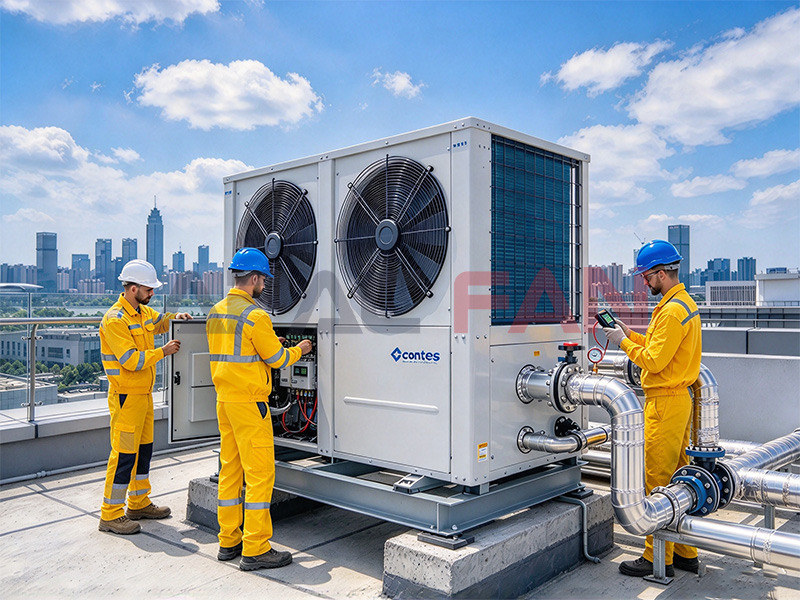
Before restarting, the service provider should check that the fan is securely mounted, rotates freely where the manufacturer's procedure permits and has the correct connections. During commissioning, observe the unit's normal heating behavior and check for unusual vibration, noise or alarms. Any testing of defrost or protective functions should follow the manufacturer's instructions.
An aftermarket retrofit should not be treated as proven merely because the fan spins. The required airflow and controller response need to be verified for the complete equipment. Send APAC FAN the original part number, equipment details and operating requirements to support a documented selection discussion.
Stocking critical replacement parts
For facilities that depend on a particular heat pump, a documented spare-part plan can shorten an unplanned shutdown. Identify the correct fan assembly from the unit's parts documentation and confirm whether the required mounting hardware, inlet ring or connector is included. An incomplete assembly may delay the repair even when the motor itself is available.
Store spare components under the manufacturer's specified conditions and protect labels and connectors from damage. Review stored references whenever equipment is modified, since a replacement based on an obsolete configuration may no longer match the installed unit. Availability and lead time should be confirmed for the exact part.
Coordinate the shutdown and return to service
Before arranging the work, confirm that the correct part, mounting accessories and any required connectors are available. The service provider should also determine how the unit will be isolated and how the replacement will be tested. For a building dependent on the heat pump, schedule the shutdown around the heating requirement and any approved backup arrangement.
After installation, retain the fan part number and the work record with the heat pump documentation. This makes future service and fault investigation easier, particularly if an approved engineering change altered the original assembly configuration.