















 English
 Français
 Deutsch
 Português
 Español
 русский
  한국어
한국어 العربية
 Italiano
 Indonesia
 Schweiz
 Polski
 Nederlands
 ישראל - עברית
 Perzisch
 ไทย
ไทย 日本語
日本語 ኢትዮ-አማርኛ
 Việt Nam
 Kiswahili
 Srpski
 Ελληνικά
 繁體中文
繁體中文Air-Cooling Fans in AI Data Centers with Liquid Cooling
09/08/2026AI Infrastructure Is Changing the Cooling Mix
AI servers can concentrate far more heat in a rack than traditional enterprise equipment. Direct-to-chip cold plates and immersion systems move a large share of that heat into a liquid loop, reducing the amount that room air must carry. This shift changes the job of the precision air conditioner, but it does not make room-level airflow unnecessary.
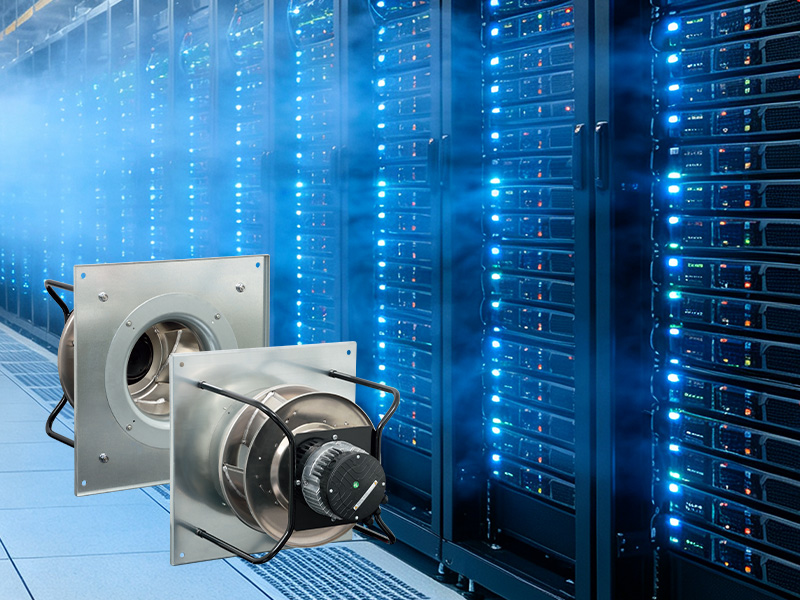
A modern AI data hall is a mixed thermal environment. Some racks may be liquid cooled, others may remain fully air cooled, and supporting electrical and network equipment continues to release heat into the room. Precision cooling fans must serve this residual load while maintaining stable temperature and humidity around all equipment.
What Still Depends on Air Cooling
Memory modules, storage devices, power supplies, voltage regulators, network switches, optical equipment, and rack-mounted control hardware may still rely on internal fans and room air. Coolant distribution units, pumps, manifolds, and power-distribution equipment also release heat. Even a liquid-cooled server normally transfers a small portion of its heat to the surrounding air.
If room airflow is reduced without measuring these loads, local temperatures can rise around components that are not connected to the liquid loop. The resulting hot spots may be difficult to see when operators focus only on coolant supply and return temperatures.
How Fan Duty Changes
In a hybrid facility, the required room airflow may be lower and more variable than in a fully air-cooled hall. Fans should be able to operate efficiently at partial load without losing stable control. Oversized fixed-speed fans can create bypass air, unnecessary power use, and room-pressure problems when the sensible load has been reduced.
The remaining duty should be calculated from actual air-side heat, the allowable room temperature difference, distribution resistance, and the needs of non-server equipment. Fan selection should also consider future transitions because the balance between air and liquid cooling may change as racks are upgraded.
Coordinating Precision Cooling with the CDU
The coolant distribution unit and the precision air conditioner should not respond independently to the same event. Control sequences can use rack inlet temperature, room dew point, air-side sensible load, and CDU status to determine the required fan speed. If a liquid loop loses capacity, the air system may provide limited support, but it should not be assumed to replace liquid cooling for high-density processors.
Alarm logic should clearly distinguish an air-side problem from a liquid-side problem. Trend data from both systems helps operators understand whether a temperature change is caused by coolant flow, residual room heat, poor airflow, or an equipment operating change.
Humidity and Condensation Control
Liquid-cooled equipment introduces cold surfaces and pipework into the technical space. Precision air conditioning remains important for controlling room dew point so that moisture does not form on coolant lines, fittings, or cold plates. Air movement improves environmental uniformity and helps sensors represent actual room conditions.
Fan speed should not be reduced below the level needed for adequate mixing and humidity control. The correct minimum is project-specific and should be verified during commissioning at low IT load and the lowest expected coolant temperature.
Designing for a Hybrid Future
A flexible design uses variable-capacity fans, distributed temperature and humidity sensing, and controls that can adapt as the data hall changes. The air system should be evaluated by zone so that mixed rows do not receive one excessive airflow setting. Physical separation may help when air-cooled and liquid-cooled racks have very different needs.
Liquid cooling changes the size and operating profile of precision air systems, but dependable fans still protect the many components and environmental functions that remain air dependent. The best design treats air and liquid as coordinated parts of one cooling strategy.
Conclusion
Hybrid cooling succeeds when room airflow is resized and controlled around the heat that remains air dependent, while humidity management and liquid-side operation are coordinated as one system.