









 English
 Français
 Deutsch
 Português
 Español
 русский
  한국어
한국어 العربية
 Italiano
 Indonesia
 Schweiz
 Polski
 Nederlands
 ישראל - עברית
 Perzisch
 ไทย
ไทย 日本語
日本語 ኢትዮ-አማርኛ
 Việt Nam
 Kiswahili
 Srpski
 Ελληνικά
 繁體中文
繁體中文Data Center Fan Maintenance, Monitoring, and Retrofit Planning
09/07/2026Fans as maintained assets, not consumables
A data center fan may look like a replaceable part, but it should be managed as a maintained asset. It affects uptime, energy, acoustics, and the operating margin of IT equipment. When fans are ignored until failure, the facility loses the opportunity to detect early warning signs such as rising speed, increasing pressure drop, unusual vibration, temperature drift, or repeated alarms.
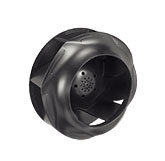
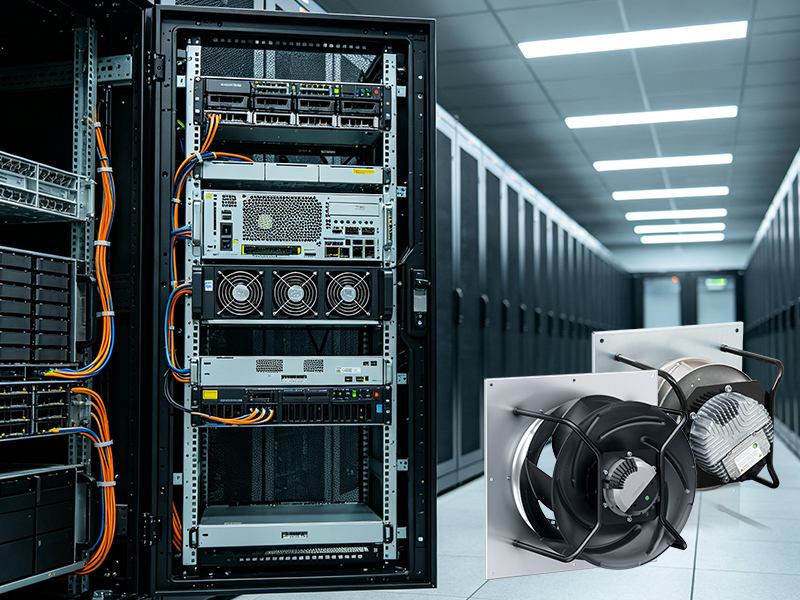
Maintenance should reflect the fan's role. A compact fan in a server tray, a RadiPac module in a FanGrid, a centrifugal fan in a CRAH unit, and a fan in a UPS cabinet do not have the same service plan. They differ in access, criticality, control interface, redundancy, and replacement procedure. A mature program classifies fan assets by application instead of applying one generic checklist to everything.
Monitoring that supports decisions
Monitoring is valuable only when it changes action. Fan speed, status, alarm state, runtime, control signal, temperature, and pressure can all help operators understand whether the cooling system is healthy. In a FanGrid, visibility into individual fan modules may help identify a weak unit before the whole array is affected. In a CRAH unit, speed trends may reveal filter loading or coil restriction. In electronics cooling, repeated fan alarms may point to a blocked air path or failing module.
ebm-papst materials discuss smart features and control options across several product families, including EC fan control, sensor signals, and fan monitoring language in compact fan materials. The exact available data depends on the model and system integration, so specifications must be verified. The operational principle is clear: fans should not be invisible until they fail.
Planning retrofits carefully
Fan retrofits can produce meaningful improvements when older systems are inefficient, hard to control, or difficult to service. However, a retrofit is not a simple swap if the new fan changes airflow, pressure, electrical behavior, controls, acoustics, or service procedures. The existing unit must be surveyed, including dimensions, airflow path, coil and filter condition, power supply, access space, safety requirements, and control sequence.
ebm-papst positions several products and services around air conditioning, data center applications, FanGrids, and retrofit fan replacement. That provides useful product direction, but not a shortcut. A retrofit should be engineered with current manufacturer data, project measurements, and commissioning tests. The correct replacement is the one that fits the actual duty and the actual facility risk profile.
Commissioning after maintenance and retrofit
After a fan replacement or retrofit, commissioning should confirm more than rotation. The team should verify airflow, pressure, speed command response, alarms, fail-safe behavior, BMS points, acoustic impact, and thermal response at representative loads. If multiple fans operate together, the system should be checked for stable staging and balanced operation. If a fan is part of a redundant group, the failure and removal scenarios should be tested where practical.
Documentation matters. Operators need to know which fan was installed, why it was selected, what setpoints changed, what alarms mean, and what spare parts are required. Without documentation, a successful retrofit can become hard to maintain two years later. In a data center, knowledge continuity is part of reliability.
A lifecycle view of fan systems
The best fan maintenance program combines inspection, cleaning, monitoring, trend analysis, and planned replacement. It also connects facility systems and IT operations. If rack density increases, fan duty may change. If containment improves, fan setpoints may be reduced. If liquid cooling is added, some air systems may become support systems while others remain critical. The fan maintenance strategy should evolve with the data center.
This lifecycle view prevents two common mistakes: leaving inefficient legacy fans in place because they still spin, and replacing fans without understanding the air system they serve. Data center fans deserve a middle path. They should be maintained, monitored, and upgraded with engineering discipline. When that happens, they support uptime quietly, efficiently, and predictably.
Application perspective
Retrofit planning should include a risk register. The team should identify what could go wrong during installation, commissioning, and future operation. Examples include incorrect rotation, communication mismatch, vibration, inadequate access, unexpected pressure drop, nuisance alarms, and insufficient spares. Naming these risks early makes the project more professional and reduces surprises.
A strong maintenance culture also celebrates quiet success. Fans are supposed to disappear into the background when they are working properly. That invisibility can make them easy to neglect. By monitoring trends, replacing parts before emergency failure, and documenting retrofit decisions, operators turn invisible components into managed reliability assets. For a data center, that is exactly the right kind of boring.
The retrofit business case should include both energy and risk. A new fan system may reduce power use, but it may also reduce belt maintenance, improve alarm visibility, simplify spare parts, or restore capacity for future IT growth. Conversely, a cheap replacement may look attractive until controls integration and downtime risk are considered. The most credible retrofit plan explains operational value in plain language before it claims financial benefit.
Spare strategy should be written down before handover. Operators need to know which modules are stocked, which require manufacturer lead time, which tools are needed, and which alarms indicate degraded redundancy. A retrofit that improves equipment but leaves the maintenance team guessing is incomplete. The final system should be easier to own than the system it replaced.
FAQ
Q: Why is fan maintenance important in data centers?
A: Fans directly affect thermal stability, equipment reliability, energy use, and alarm response. Poor maintenance can increase pressure drop, reduce airflow, and create avoidable risk.
Q: What should be monitored?
A: Useful signals include fan speed, status, alarms, runtime, temperature, pressure, filter condition, and control output. Available signals depend on equipment design.
Q: When should a fan retrofit be considered?
A: Retrofits may be considered when older fans are inefficient, difficult to maintain, poorly controlled, unreliable, or unable to support new load profiles.
Q: Can ebm-papst fans be used for retrofits?
A: ebm-papst offers retrofit-oriented fan solutions and data center application products, but any retrofit must be engineered against the actual unit geometry, duty point, controls, and approvals.
Q: What is the most common retrofit mistake?
A: The common mistake is replacing a fan without redesigning or commissioning the system around real airflow, pressure, control, and service requirements.