















 English
 Français
 Deutsch
 Português
 Español
 русский
  한국어
한국어 العربية
 Italiano
 Indonesia
 Schweiz
 Polski
 Nederlands
 ישראל - עברית
 Perzisch
 ไทย
ไทย 日本語
日本語 ኢትዮ-አማርኛ
 Việt Nam
 Kiswahili
 Srpski
 Ελληνικά
 繁體中文
繁體中文Cooling Tower Fan Control for Changing Cooling Demand
09/30/2026Why cooling tower airflow needs control
The fan should deliver enough airflow to maintain the required water temperature, but full output is not necessary under every condition. Heat load and entering-air wet-bulb temperature vary over hours and seasons. Control links the fan output to these changes, helping the tower avoid both insufficient cooling and unnecessary fan power.
On off control
The simplest strategy starts and stops a fixed-speed fan around a water-temperature setpoint. It can work in small or lightly used systems, but the temperature may swing between start and stop points. Frequent cycling can increase electrical and mechanical stress. A suitable differential and minimum on and off times are needed to prevent rapid cycling, and the controller should account for the delay between a fan change and the measured water-temperature response.
Staged fan control
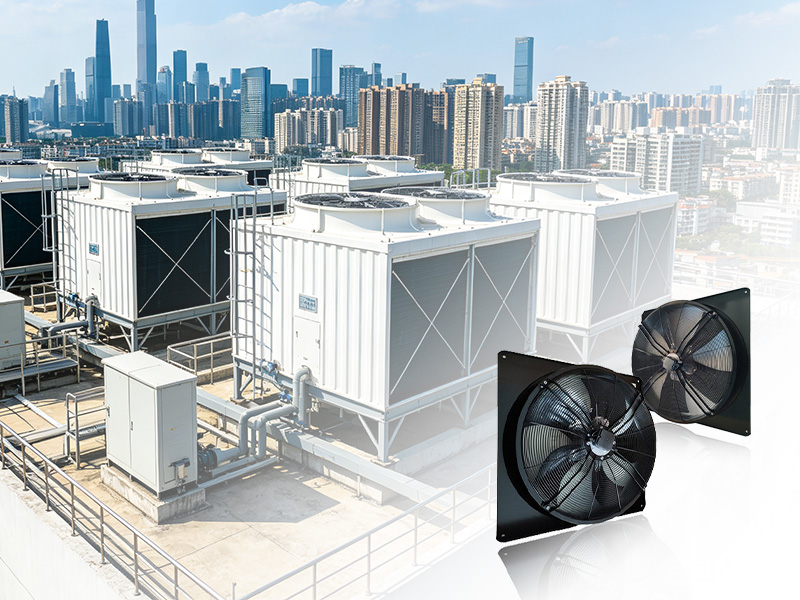
Towers with multiple cells or fans can add and remove fan capacity in stages. The sequence should respect minimum water flow, cell availability, and tower design. Equal-runtime rotation may distribute operating hours, while lead-lag logic can preserve redundancy. Staging alone provides coarse capacity steps; variable speed can be added within each stage for closer temperature control.
Variable speed control
A controller can modulate fan speed from the measured cold-water temperature. Proportional-integral control is often used, but tuning must reflect tower response time and sensor location. Excessive gain may cause hunting, while weak response may allow large temperature deviations. Minimum speed, maximum speed, ramp rates, and safe behavior after signal loss should be defined during design.
Control signals and EC fans
Depending on the exact product, an EC fan may accept an analog command such as 0 to 10 V, a PWM signal, or digital communication. Some fans also provide a tachometer, relay, alarm, or data interface. These functions are model-specific. When integrating an ebm-papst EC fan or another EC solution, confirm signal type, reference potential, input impedance, cable requirements, addressing, parameter settings, and fault behavior from the applicable documentation.
Multiple fan sequencing
One strategy runs several fans at similar low speed to use more tower surface area. Another stages fans and modulates only the active group. The energy and thermal results depend on fan efficiency, cell water flow, tower geometry, and minimum operating limits. The sequence should also avoid backflow through idle fans and recirculation between cells. Field testing can show which strategy maintains the setpoint with the lowest total plant power.
Coordinate with the chiller or process
A lower condenser-water temperature may reduce chiller power, but it requires additional tower airflow and may be limited by chiller controls. The optimum setpoint can therefore change with ambient conditions and plant load. In industrial service, the process may impose a fixed maximum supply temperature instead. Fan control should follow the requirements of the connected system and should not use an arbitrary low setpoint.
Monitoring and alarms
Useful points include commanded speed, actual speed where available, run status, fault status, water temperatures, ambient wet-bulb or related weather data, and fan power. Alarms should distinguish a high-water-temperature condition from a fan fault because their responses may differ. Trend data helps identify fouled fill, drifting sensors, rising fan power, or a loss of airflow before the tower reaches a critical condition.
Retrofit considerations
A control upgrade may require new sensors, cables, panels, drives, gateways, or software changes. Verify compatibility with the existing building or plant automation system. Preserve local isolation and safe maintenance procedures. Commission the system under several load points, test failed sensors and communications, and document setpoints, limits, alarm delays, and manual override behavior.
Conclusion
Effective fan control matches cooling tower airflow to real thermal demand. The best strategy may combine staging and variable speed, but it must be tuned for the tower, coordinated with the connected equipment, and supported by clear limits, alarms, and fallback behavior.