
















 English
 Français
 Deutsch
 Português
 Español
 русский
  한국어
한국어 العربية
 Italiano
 Indonesia
 Schweiz
 Polski
 Nederlands
 ישראל - עברית
 Perzisch
 ไทย
ไทย 日本語
日本語 ኢትዮ-አማርኛ
 Việt Nam
 Kiswahili
 Srpski
 Ελληνικά
 繁體中文
繁體中文Cooling Tower Fan Retrofit and Replacement Planning
09/29/2026Why cooling tower fans are upgraded
A retrofit may be driven by insufficient heat rejection, high power use, unavailable spare parts, corrosion, repeated motor failure, excessive noise, vibration, or a need for better capacity control. These symptoms do not automatically prove that the fan is the root cause. A sound retrofit begins by documenting the problem and inspecting the tower as a complete air and water system.
Separate fan problems from tower problems
Reduced cooling can result from fouled fill, blocked louvers, damaged drift eliminators, poor spray distribution, incorrect water flow, recirculation of discharge air, or unusually severe ambient conditions. Fan-side causes include wrong rotation, reduced speed, blade damage, excessive clearance, motor loading, and control faults. Correcting tower resistance or water distribution may restore performance without a larger fan.
Measure the existing installation
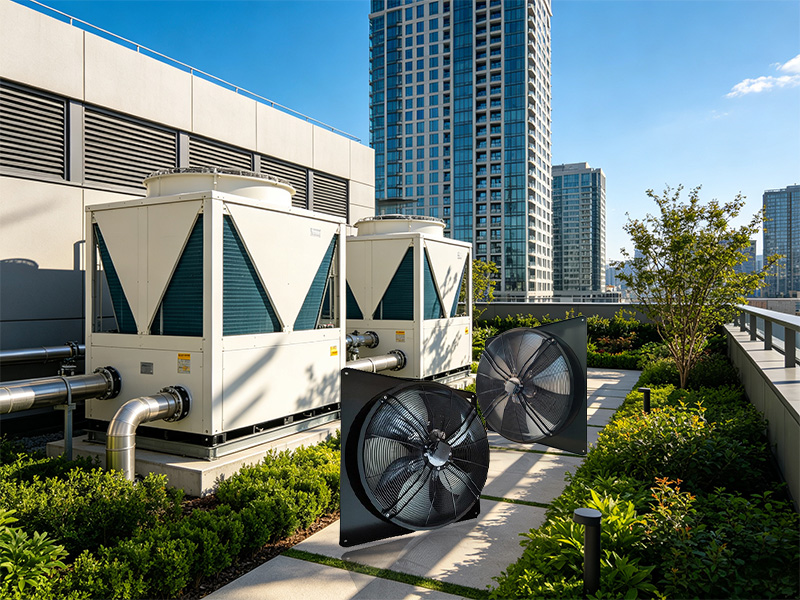
Record the fan diameter, opening, ring profile, depth, mounting points, support frame, airflow direction, available inlet and outlet space, electrical connections, cable routes, and access path. Note the fan and motor nameplate data, speed-control equipment, guards, vibration isolators, and controller signals. Photographs with dimensions are particularly helpful when the new assembly will be prepared away from the site.
Establish the required duty point
Use original design information where it remains valid, but compare it with present operating conditions. Determine the airflow and pressure needed for the tower's thermal duty. If the system resistance is uncertain, measure pressure or develop an estimate from the tower components. A replacement fan should be chosen from its curve at the required operating point, with motor power and current checked throughout the expected speed range.
Consider EC fan solutions
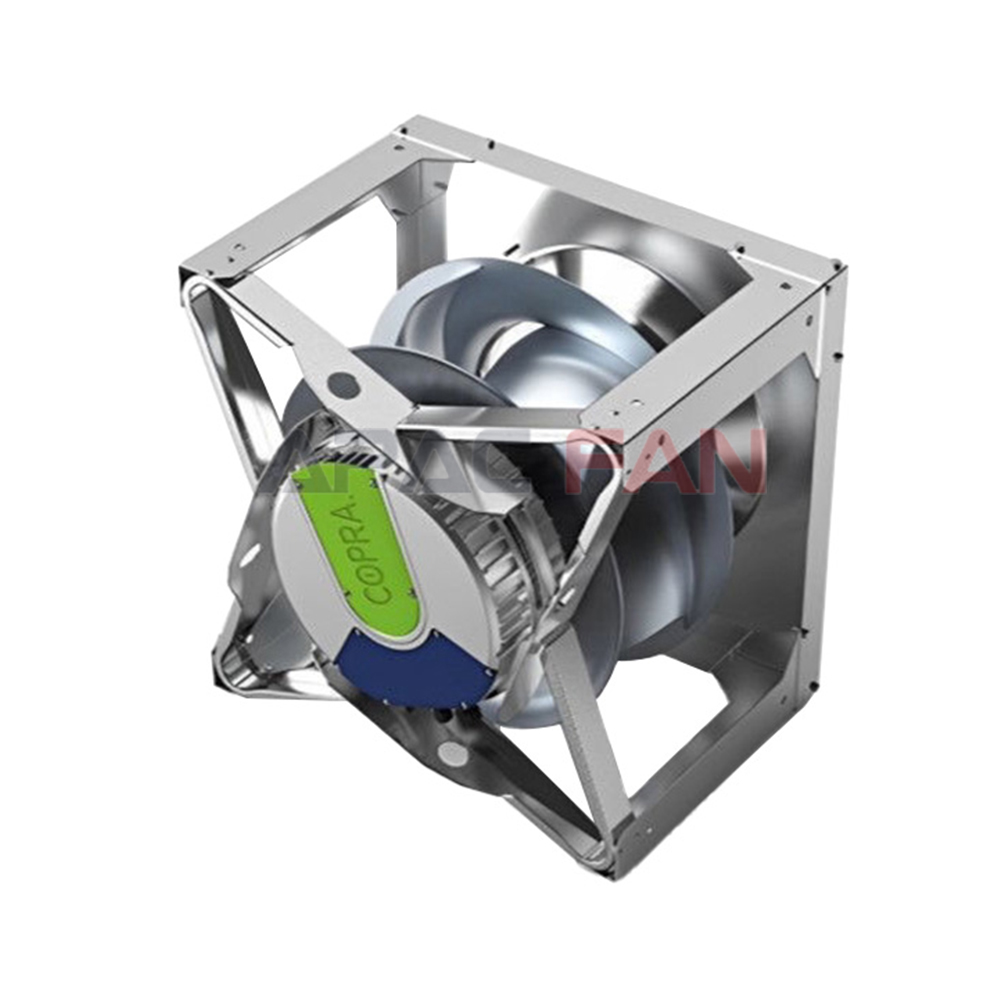
An EC fan can be attractive where the retrofit requires efficient variable-speed operation and a suitable product matches the mechanical and environmental constraints. For example, selected ebm-papst EC fan technologies may accept a control signal and provide operating feedback. The exact capabilities and protection level must be checked for the chosen model. Large structural changes should not be justified solely by the availability of integrated control.
Electrical and control compatibility
Confirm voltage, phase, frequency, protective devices, isolation, earthing, cable size, electromagnetic compatibility requirements, and available control signals. A new fan may have different starting current, harmonic behavior, leakage current, or fault reporting than the old arrangement. The tower controller should define temperature control, speed limits, alarms, fallback operation, freeze protection where applicable, and the response to sensor or communication failure.
Mechanical and structural work
The support frame must carry the new fan's static and dynamic loads. Check bolt locations, stiffness, corrosion, guard clearances, center of gravity, and safe access. An adapter plate may simplify installation, but it must not obstruct the inlet or create a recirculation path. Seal unintended gaps around the fan, preserve drainage, and use fasteners and materials appropriate for the wet environment.
Commissioning after retrofit
Verify rotation and airflow direction before extended operation. Measure current, input power where possible, vibration, noise, speed response, and water temperatures. Test the full control range and all alarm contacts. Inspect for contact between moving and stationary parts, cable movement, loose fasteners, and abnormal resonance. Where several cells are involved, confirm that the sequencing maintains balanced water distribution and stable leaving-water temperature.
Confirm results with comparable data
Post-retrofit evaluation should compare conditions with similar heat load and ambient wet-bulb temperature. Useful measures include fan energy, operating hours, speed profile, leaving-water temperature, approach, chiller or process performance, sound, and maintenance observations. A successful retrofit meets the cooling requirement and produces a measurable operational improvement without introducing structural, electrical, or control problems.
Conclusion
Cooling tower fan replacement is an engineering project rather than a simple model swap. Inspection, duty-point verification, dimensional checks, electrical design, control integration, structural review, and commissioning determine whether the new fan produces the expected airflow and energy result.