

















 English
 Français
 Deutsch
 Português
 Español
 русский
  한국어
한국어 العربية
 Italiano
 Indonesia
 Schweiz
 Polski
 Nederlands
 ישראל - עברית
 Perzisch
 ไทย
ไทย 日本語
日本語 ኢትዮ-አማርኛ
 Việt Nam
 Kiswahili
 Srpski
 Ελληνικά
 繁體中文
繁體中文Cooling Tower Fan Energy Efficiency Through Variable Speed Operation
09/28/2026Why fan energy deserves attention
Cooling tower fans may run for many hours in HVAC and industrial plants. Even when one fan represents a modest share of total plant demand, continuous full-speed operation can accumulate substantial energy use. The main opportunity is often not a small improvement at the rated point. It is avoiding full fan output when the tower can meet its water-temperature target with less airflow.
Cooling demand changes
A tower designed for peak summer conditions may spend much of the year at lower ambient wet-bulb temperatures or reduced heat load. Building occupancy, production rate, chiller staging, and process schedules also change the rejected heat. Fixed-speed operation usually responds through cycling or fan staging. Variable-speed operation adds a finer adjustment, allowing airflow to follow the actual condition more closely.
Speed airflow pressure and power
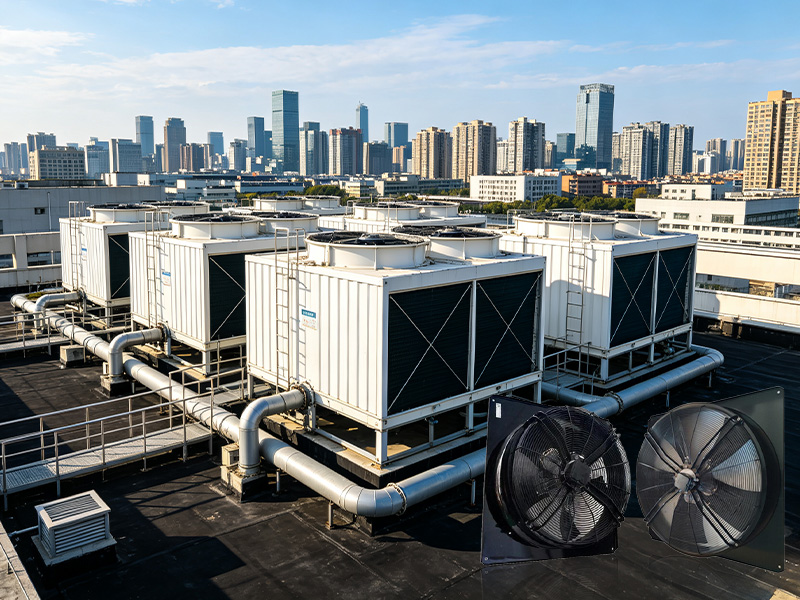
For a geometrically unchanged fan operating in a suitable system range, the fan affinity laws provide a useful estimate. Airflow changes approximately in proportion to rotational speed, pressure changes approximately with speed squared, and power changes approximately with speed cubed. A fan at 80 percent speed may therefore require much less than 80 percent of full-speed power. Real results depend on motor and drive efficiency, system resistance, control limits, and the selected operating point.
Maintain the thermal target
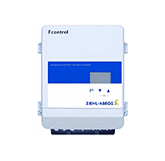
Energy reduction must not compromise required condenser-water or process-water temperature. A controller should use a reliable temperature signal and adjust fan speed within safe limits. The setpoint should reflect the needs of the connected equipment. Driving the water temperature lower than necessary can waste fan energy, while allowing it to rise too far may increase chiller power or reduce process capacity. Plant-level optimization should consider both sides of that tradeoff.
EC motors and other variable speed systems
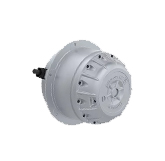
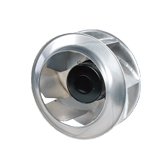
EC fans provide integrated electronic commutation and speed control in suitable sizes and configurations. Conventional motors may use a compatible variable-frequency drive. Either approach can be effective when it is properly selected. Compare the complete efficiency chain at relevant loads, including motor, electronics or drive, cables, filters where needed, and the fan aerodynamic efficiency at each operating point.
Control of multiple fans
A multi-cell tower can vary the speed of all available fans together or stage cells and modulate the running fans. The best sequence depends on tower design, water distribution, minimum flow per cell, motor efficiency, and fan performance. Operating more heat-transfer area at lower fan speed can be efficient in some plants, but unused cells and poor water distribution may reduce the benefit. The sequence should be tested against actual water temperature and power data.
Evaluate a retrofit with measurements
Begin with operating hours, fan power, water temperatures, wet-bulb conditions, heat load, and current control behavior. A short data-logging period is more useful than a single spot reading. Estimate the proposed speed profile and expected power, then include any changes to fans, motors, drives, panels, sensors, wiring, and controls. After installation, compare performance under similar conditions and confirm that the expected temperature target remains satisfied.
Avoid common efficiency mistakes
Oversizing can force a fan to operate inefficiently or require permanent throttling. A heavily fouled tower can consume more fan energy while still delivering poor cooling, so cleaning and airflow-path repairs may precede a fan upgrade. Excessively low minimum speed can cause unstable airflow or inadequate motor cooling in some arrangements. Poorly tuned controls can create speed hunting and frequent starts. Each of these issues should be addressed during design and commissioning.
Conclusion
Variable-speed operation reduces cooling tower fan power by matching airflow to real demand. The energy result is strongest when selection uses the actual fan and system curves, the controller protects the required water temperature, and savings are verified with operating data rather than assumed from motor size alone.